Everyday Chemicals and Hormone Health: What Actually Matters
It is easy to look around your home and start questioning everything.
The plastic container. The air freshener. The products sitting beside your sink.
Some everyday substances are being studied for how they may affect the body’s hormone systems. That does not mean every product is dangerous or that you need to replace everything you own.
The useful question is not, “How do I remove every chemical from my life?”
It is, “Which exposures are worth reducing, and which changes can I realistically maintain?”
The goal is not to remove every chemical from your life. It is to reduce the exposures that are easy to avoid.
What are we actually talking about?
Your endocrine system uses hormones to help regulate growth, metabolism, reproduction, stress responses and other functions.
Some substances may interfere with normal hormone activity. They may imitate a hormone, block its action or affect how hormones are produced and processed. These substances are often described as endocrine-disrupting chemicals.
That sounds alarming until we add the part that is often left out: exposure matters.
A chemical’s ability to cause an effect at one level does not prove that normal contact creates the same risk. The amount, timing and length of exposure all matter. Different chemicals also have different evidence and regulations.
This is not a reason to ignore the research. It is how we make better decisions without treating every product in the house like an emergency.
What about phthalates?
Phthalates are a large group of chemicals used to soften some plastics. They may also be used as solvents in cosmetics, household products and other consumer goods.
They are not all the same.
Health Canada says that most phthalates it has assessed do not pose a health risk at current Canadian exposure levels. DEHP is an exception and is subject to Canadian restrictions and risk-management measures.
If you want to reduce exposure to DEHP, Health Canada suggests choosing products labelled phthalate-free or PVC-free. Recycling code 3 can help identify PVC, although it does not provide a complete ingredient list.
If you are unsure about a product, check the manufacturer’s directions or contact the company.
What about BPA?
BPA is used in some hard plastics and protective linings for food and beverage containers.
It has received years of public attention, especially in relation to food packaging. Health Canada’s current position is that exposure to BPA from food packaging does not pose a health risk to Canadians, including infants.
Canada has still taken added precautions. Polycarbonate baby bottles containing BPA are prohibited, and Health Canada continues to monitor new evidence and exposure levels.
Both things can be true. A chemical can deserve continued research and regulation without every exposure creating an immediate health problem.
What does this mean for fertility?
Environmental exposures are one area of continuing fertility and reproductive-health research.
Population studies can identify patterns. They cannot tell one person exactly why they are experiencing a fertility concern.
Fertility can be influenced by many biological, medical, behavioural and environmental factors. Exposure may be one part of that picture, but it is not a personal diagnosis.
If you are concerned about fertility, pregnancy, menstrual changes or reproductive health, speak with a physician or another qualified health professional. Do not start or stop a medication or supplement because of something you read online.
Five changes that are actually practical
You do not need to throw everything out. Start with choices that are easy to understand and repeat.
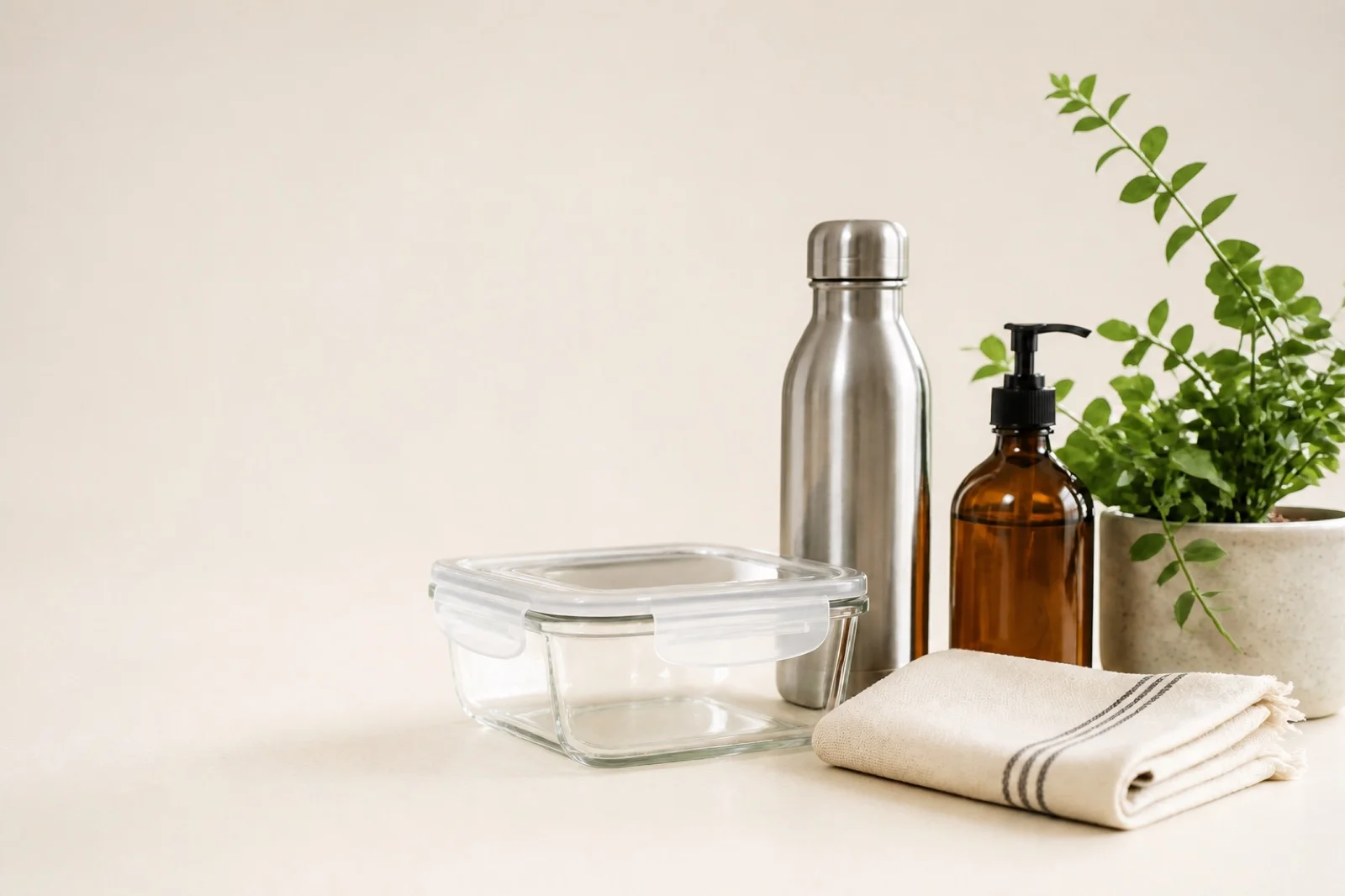
Use containers for their intended purpose. Store food in food-grade containers. Glass and stainless steel are practical options. Avoid pouring hot food or liquid into plastic containers that were not designed for heat. Health Canada notes that substances added to plastics are more likely to transfer into food at higher temperatures.
Check before microwaving plastic. Use containers, lids and wraps labelled microwave-safe. Takeout containers, foam trays, margarine tubs and other single-use packages should not go in the microwave unless the packaging specifically says they are safe for that use. Damaged, stained or unpleasant-smelling plastic containers should also be replaced.
Read the label. Use household and personal-care products as directed. If you want to reduce exposure to a particular substance, look for a specific label rather than relying on broad terms like “clean,” “natural” or “non-toxic.” Those words can sound reassuring without telling you exactly what is in the product.
Reduce exposures you do not need. You do not need to treat every scented product as dangerous. But if a plug-in or aerosol air freshener is not serving a real purpose, using less of it is a simple change. Health Canada recommends minimizing scented air fresheners and increasing ventilation when using products that release volatile organic compounds. Regularly cleaning dust from hard surfaces with a wet cloth or mop can also reduce dirt and other substances carried into the home.
Return unused medications to a pharmacy. Expired and unused prescription drugs, non-prescription medications and natural health products should not be flushed or poured down a drain. They can be returned to a Canadian pharmacy for proper disposal.
What not to do
Do not let the search for lower exposure become another source of anxiety.
No home is completely chemical-free, and “chemical-free” is not a useful target. The real questions are what the substance is, how you are exposed to it and whether that exposure creates a meaningful risk.
You also do not need an expensive detox, a cupboard full of supplements or an immediate replacement for everything made of plastic.
Start with the obvious changes. Use products as directed. Avoid unnecessary exposure where it is practical. Ask questions when something does not make sense.
How Kiwi Pharmacy can help
Questions about hormone health, fertility, medications and environmental exposure can overlap. They are still different questions, and no single test, product or household change gives the complete answer.
Kiwi Pharmacy & Wellness can explain how prescription compounding works, answer general medication questions and coordinate with an authorized prescriber when appropriate.
Kiwi does not diagnose infertility, and speaking with a pharmacist does not replace an assessment from a physician or fertility specialist.
Have a question about hormone therapy or a compounded prescription? Call Kiwi Pharmacy & Wellness in Kelowna at 778-940-1950 or ask about a Compounding Consultation.
Book a Compounding Consultation
This article is for general educational purposes. It is not medical advice and does not replace an individual assessment by a qualified health professional.