What is microneedling? How it works and what it can change
Microneedling is a skin treatment that uses very fine needles to create small, controlled punctures. Those tiny injuries activate the skin’s repair process, encouraging the production of collagen and other supporting tissue. Over time, this can improve the appearance of fine lines and uneven texture.
You may also see it called collagen induction therapy. The name describes the idea behind it: the treatment prompts your skin to make structural material as it heals. Understanding that process helps explain both its potential benefits and why the results take time. Cleveland Clinic’s microneedling overview
What happens beneath the skin?
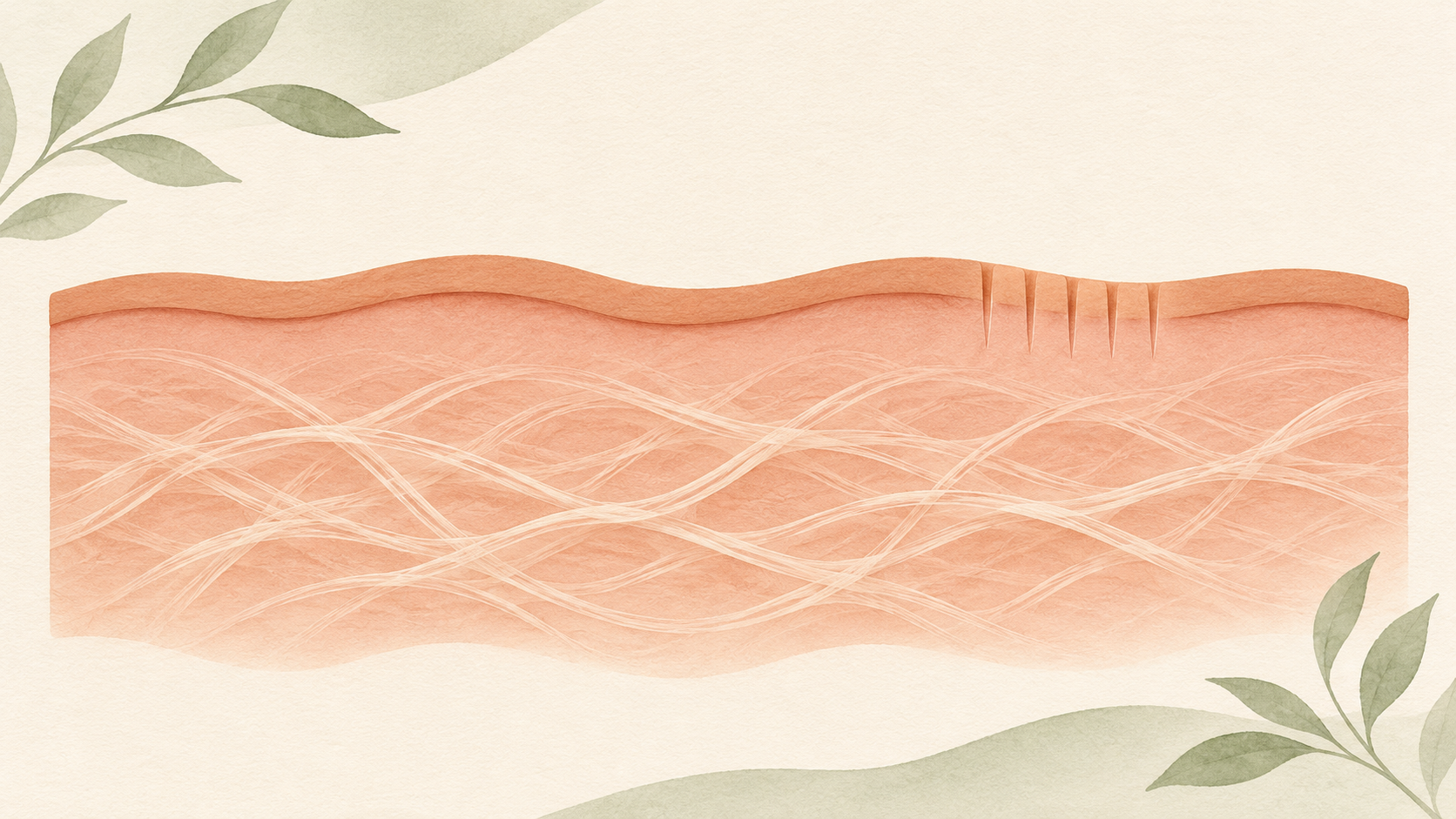
The visible surface is only part of your skin. Underneath it is a supporting layer containing collagen, a protein that provides strength and structure. Elastin helps skin stretch and return towards its original shape. Together, these materials influence how skin feels and looks.
A professional microneedling device creates many small punctures as it moves across the treatment area. In a pen-style device, the needles move up and down; the treatment depth can be adjusted. This physical action reaches beyond the surface exfoliation produced by microdermabrasion. Cleveland Clinic: how the procedures differ
The response unfolds in stages. First, the tiny injuries trigger inflammation and the release of chemical signals involved in repair. Those signals help coordinate the work of cells rebuilding the affected tissue. New collagen and elastin are produced as healing progresses. The longer-term changes in that supporting tissue are what the treatment is intended to encourage. DermNet’s explanation of skin needling
“Controlled injury” can sound counterintuitive. The purpose is to create a limited repair stimulus across the treatment area. That does not mean more injury produces a better result: depth, technique and the condition being treated matter. The biological response also explains why an immediate change in appearance cannot tell the whole story about the eventual outcome.
What is microneedling used for?
Professional microneedling is used to improve the appearance of uneven texture, fine lines, some scars and stretch marks. These concerns can involve changes in the skin’s supporting structure, which makes collagen remodelling relevant. Improvement means a feature may become less noticeable; it does not mean that the skin becomes flawless. DermNet: uses of skin needling
A broad label such as “skin rejuvenation” can hide important differences. Fine lines, loose skin and a patch of discolouration are not identical problems. A treatment that changes texture may not address the main reason an area looks different. This is why the specific concern matters more than the general promise of better skin.
The evidence is also specific. The FDA has authorized particular devices for particular uses, including improving facial wrinkles and certain scars. That does not establish that every device, body area or advertised use has equivalent support. US authorization also does not establish Canadian authorization for a particular device. FDA microneedling device guidance
Why do results take weeks or months?
Collagen production and tissue remodelling continue after the treatment itself is over. The American Academy of Dermatology describes improvement becoming visible within weeks, with fuller results generally taking several months. Some people need a series of treatments, and improvements may fade over time as collagen is lost. AAD: results and duration
This creates two different timelines. One is the short-term settling of treated skin. The other is the slower development of the intended cosmetic change. A face that looks calmer after a few days has not necessarily reached its final result.
There is no universal number of sessions that produces the same outcome for everyone. Skin characteristics, the concern being treated and the treatment approach all affect the plan. A photograph taken immediately afterwards cannot show the complete result of a process that develops over months.
What does recovery look like?
Treated skin can temporarily look red or darker than usual and feel warm, swollen or uncomfortable. The AAD says these reactions usually settle within a few days to a week, although individual recovery varies. That visible reaction is part of the immediate aftermath, not a reliable measure of how much improvement will follow. AAD: recovery
Skin can also be more sensitive to products during recovery. The FDA identifies redness, bruising, bleeding, tightness and peeling among possible effects. Less common problems include infection, changes in pigmentation and cold-sore flare-ups. Microneedling is not suitable for everyone, particularly where health conditions or medicines affect bleeding, immunity or healing. FDA safety guidance
Is radiofrequency microneedling the same thing?
Conventional microneedling relies on the physical action of needles. Radiofrequency, or RF, microneedling also delivers electrical energy that heats tissue through the needles. The addition of heat changes the treatment and its risk profile.
In October 2025, the FDA warned about reports of serious complications with certain uses of RF microneedling, including burns, scarring, fat loss and nerve damage. Those reports concern RF devices; they should not be used to describe every conventional microneedling procedure. Equally, the two approaches should not be presented as interchangeable. FDA RF safety communication
What about at-home rollers?
Home devices are not equivalent to professional treatment. Some are designed to act more superficially, while improper pressure or use can injure skin. The AAD warns that home microneedling can cause infection, scarring and changes in colour or texture. A similar-looking tool does not reproduce professional assessment, technique or infection control. AAD: at-home microneedling
Microneedling at Kiwi
At Kiwi Medical & Aesthetics in Kelowna, we use COSMOPen for conventional microneedling. We assess your skin and goals to determine whether it is appropriate and explain the expected benefits, limitations and recovery. Our microneedling service page has more information about the treatment we offer.
This article is general educational information, not individual medical advice.